
Meaning of St. Joseph County Property Value
Three numbers get called a property value, yet they are not interchangeable. Assessed value belongs to the assessment system and the tax roll. Market value-in-use is Indiana's legal valuation standard. A reported sale price belongs to one transaction. Its terms may not match other parcels at all. Keep the labels straight.
| Value type | What it means | Where it is recorded |
|---|---|---|
| Assessed value | The mass-appraisal figure used in the tax system | XSoft card and Indiana Gateway |
| Market value-in-use | Indiana's standard based on the property's use and market evidence | Assessment methodology and notice |
| Last sale price | The amount tied to a specific conveyance, subject to its terms | Sale disclosure, deed index, and assessment record |
| Land and improvement split | The assessed allocation between site and structures | Property-record card |
The tax bill plays a different role. It layers on deductions, credits, district rates, and payment status. So it is not a fourth market estimate. Bill mechanics stay on the St. Joseph County property tax records page. Use the county card, sale data, and assessment rules here to understand the value itself.
Indiana's St. Joseph County Assessment Ratio
The Indiana Department of Local Government Finance sets a 100 percent assessment ratio statewide. The valuation standard is market value-in-use. Ratio studies compare assessed values against sale prices. Annual adjustments, called trending, have been part of the system since 2002.
That ratio is no promise. One assessed value may not match one recent sale. A transfer might not be arm's length, and mass appraisal applies shared models across many parcels. Relevant dates, use, physical traits, neighborhood models, and sale conditions all shape the comparison.
Find a St. Joseph County Assessed Value
The XSoft assessment portal takes an owner name, address, or property number. Suggestions can display State Number, Owner, Address, and Assessed Value. For a real value inquiry, pin down the right parcel first. Then read the full card instead of trusting the suggestion line.
- Search the situs address in XSoft and confirm the state parcel number and legal description.
- Record land value, improvement value, total gross assessed value, tax year, and pay year.
- Open the PARCPRC card through the Assessment Neighborhood Map and capture its update year.
- Compare sale disclosure and deed evidence only after checking the sale date and parcel match.
The captured advanced-search screen shows the depth of the county's assessment filters.
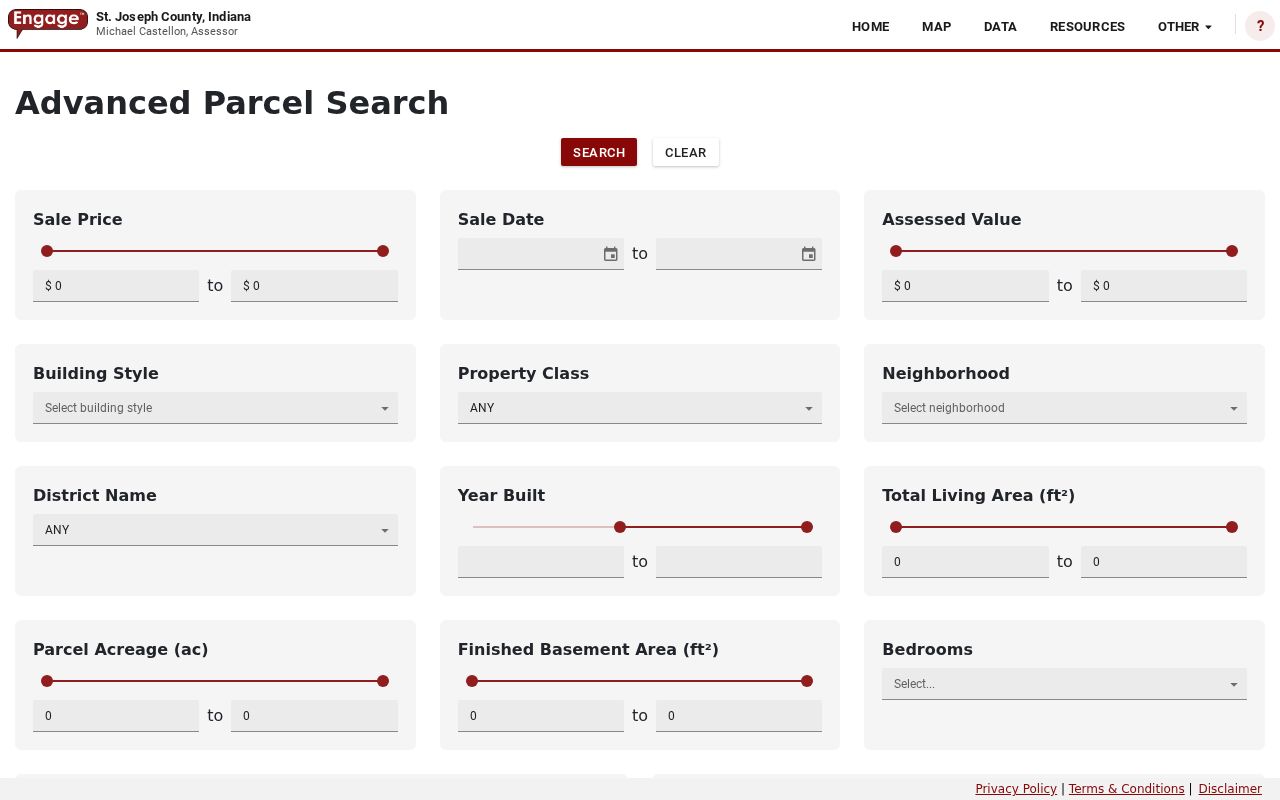
Its sale, assessed-value, district, neighborhood, building, and size controls support comparison work. Still, each result needs a parcel-level check before it counts.
- Assessed value
- The value assigned through the county assessment process.
- Market value-in-use
- Indiana's standard for how the property is used in its market.
- Assessment ratio
- The relationship between assessed and market evidence, set at 100 percent in Indiana.
- Sale consideration
- The transaction amount reported with a conveyance, subject to the sale's terms.
- Reassessment
- A review that updates property facts and valuation on the state's cycle.
St. Joseph County Property Card Details
The county's Assessment Neighborhood Map links selected parcels to a PARCPRC property-record-card PDF. A card can hold land and improvement values, year built, building style, stories, bedrooms, living area, basement area, acreage, property class, district, and assessment neighborhood.
Those facts explain a model result. A parcel with the wrong square footage, class, or style may need a factual correction first. Until then, value comparison makes little sense. Also note that a tax neighborhood is an assessment grouping, not proof of a subdivision, zoning district, or city neighborhood.
Timing matters too. The map's linked card updates once a year. Save the displayed year. Do not assume its owner or value is as current as the map's parcel attributes.
XSoft's advanced controls can narrow by sale price and date, assessed value, year built, living area, acreage, basement area, bedrooms, stories, housing plan, building style, property class, neighborhood, and district. These are filters, not a certified comparable-sales report. A broad property search can surface candidates, but each one must be checked for the same use, parcel type, date, and physical facts.
Sale Evidence for St. Joseph County Values
The Indiana sales-disclosure database offers a statewide route to reported sale facts and ratio research. Treat a sale price as evidence, not a universal answer. Financing can distort a transfer. So can related parties, property condition, or included personal property. Other terms can make a transfer unlike the subject parcel, too.
Match the full parcel key, legal description, recording date, and transfer date. The Recorder index may show a consideration field where indexed. The deed image and sales disclosure add context. A mortgage amount is neither sale price nor assessed value.
Note: A nearby sale helps only after checking. Check its parcel, date, use, and transaction conditions first.
When St. Joseph County Values Change
Indiana pairs annual adjustment with cyclical reassessment. Label any current St. Joseph County property value by assessment date and tax year. Do not treat it as timeless. New construction can shift the next record. A corrected property characteristic, local sale trends, or a parcel split can do the same. Reassessment work can shift it too.
The county's data runs on separate clocks. GIS map attributes are described as updating every two weeks. The linked PARCPRC cards update once a year. A mismatch may reflect timing rather than an error. But it still needs to be logged and checked.
A sale or title change can affect deductions without changing the valuation method. The Auditor says deductions are generally not refiled every year. Reapplication is required after a sale or title change, though. Keep taxable value and gross assessed value distinct. That way a deduction change is not mistaken for a new assessor estimate.
Gateway Confirms County Assessment Fields
The official Gateway assessed-value search notes that available fields vary by county. Users can search with partial street or name text. Results can include a Details view and a Download option, with gross assessed value representing total land and improvements.
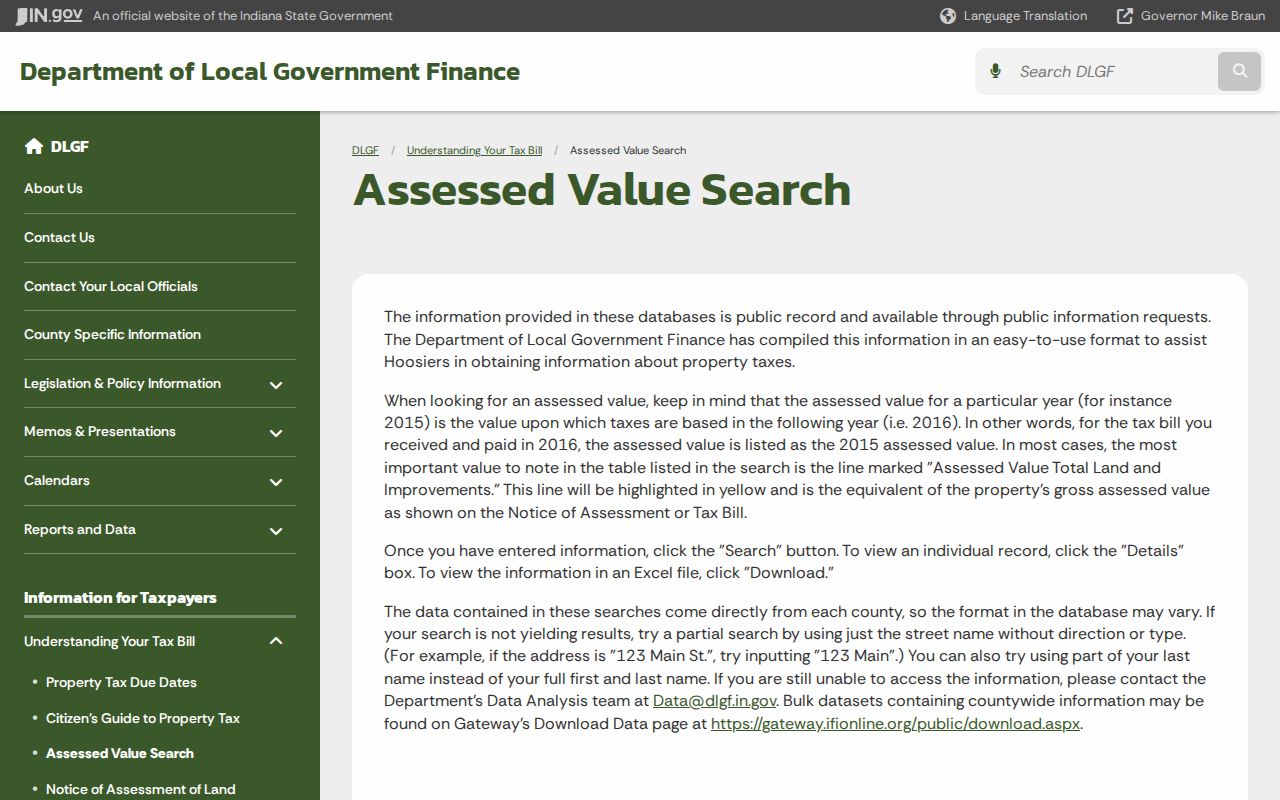
Use its year and gross-value labels when reconciling a county card. For parcel-specific questions, return to the Assessor.
St. Joseph County's Value Indiana Pilot
St. Joseph County appears in a Value Indiana pilot. It is described in Board of Commissioners materials from March 2026. The county was one of only two jurisdictions statewide taking part. The vendor, Soka Inc., works with county CAMA data and verified sales. CAMA stands for computer-assisted mass appraisal. The proposal centers on comparable-property work and market-value-in-use analysis for the county's tax roll.
Treat the pilot as a signal of current attention to valuation practice. It is not proof that any parcel's assessed value moved. A real valuation claim in St. Joseph County still needs the parcel card, the notice, the valuation year, and the source date. The pilot does not replace the official record.
Limits of St. Joseph County Property Value
An assessed value exists for one purpose: property taxation. It is spread across a class of parcels, not tailored to a single house. So it is not a listing price. It is not an offer, a guaranteed sale price, or a private appraisal. Even the latest sale price can mislead. The transaction may have been unusual, or the property may have changed since closing.
Before a purchase or sale decision, weigh the verified parcel facts and the current condition. Also weigh qualified comparable sales, and a professional appraisal when the stakes justify one. Keep the assessment as one defined data point in the St. Joseph County tax roll rather than relabeling it as today's market worth.
When a value looks wrong, check the basics first. A mismatched unit or a short parcel ID instead of the full one explains many surprises. So does a changed street address, a split or consolidation, or a stale card. Then preserve the notice date and every supporting document. Indiana's appeal window generally runs 45 days after Form 11. The property-tax page covers the filing steps. The key point here is narrower: an appeal record disputes an assessment. It does not establish a market sale price.
Value is not price. A St. Joseph County assessed value is for taxation and is not an appraisal or promised sale amount.