
Types of St. Joseph County Deeds
Deed records in St. Joseph County cover more than everyday sales. Transfers also flow from probate estates, court orders, and tax sales. Each is recorded with its own instrument. The deed type tells you what role a document plays. Its actual effect still comes from the language inside, the legal description, and the signatures. Any earlier records it references matter too.
| Deed Type | What It Does | Common Use |
|---|---|---|
| Warranty deed | Conveys the described interest with stated title promises | An arms-length sale or other full conveyance |
| Quitclaim deed | Transfers whatever interest the grantor has without the same promises | Family transfer or correction |
| Trustee or representative deed | Conveys in a stated trust or estate capacity | Trust administration or probate |
| Sheriff or commissioner deed | Follows a court-authorized sale or order | Foreclosure, partition, or other judicial transfer |
| Tax deed | Records a transfer after the tax-sale process | Completion of a delinquent-tax sale |
Deeds recorded in St. Joseph County range from routine sales to transfers forced by estates, courts, and tax sales. The label on the instrument only hints at its role. What actually controls is the deed's own language, its legal description, the signatures, and any records it references. The deed's language matters first. So does its legal description, its signatures, and any records it references.
St. Joseph County Grantor-Grantee Links
The grantor-grantee index is built around people and instruments. Start from the newest deed matching the parcel's legal description. The grantor transferred the stated interest and the grantee received it. Then search that earlier grantor's own name as a grantee, and you step back one link in the chain of title for the St. Joseph County property.
- Find the latest deed with the displayed current owner as grantee.
- Open the image and copy its grantor, recording date, instrument number, and legal description.
- Search that grantor as a grantee, using name variants and land text to isolate the prior deed.
- Repeat while checking plats, court files, and deed books when an online chain stops.
- Grantor
- The party transferring the stated interest.
- Grantee
- The party receiving the stated interest.
- Chain of title
- The linked sequence of conveyances for the same land.
- Book and page
- A volume-and-page reference used for recorded material.
- Instrument number
- A unique recording reference assigned to a filed document.
Obtain a St. Joseph County Deed
Begin with an online image if the product you use offers one. The Recorder's Laredo page describes digital images for documents recorded from January 1992 forward, though that statement does not mean older deeds are missing. For earlier volumes, partial images, or an official copy, contact the Recorder at 227 W. Jefferson Boulevard, Room 321, South Bend, or call 574-235-9525 and ask about counter or mail service. When you order, supply the instrument number, recording date, party names, and book and page if known.
The county fee page lists a schedule effective July 1, 2017, with $1 per standard copy page and $5 for certification. That schedule is dated. Confirm the current charge and the office's accepted request details before you commit to an order.
Recorded, not guaranteed. St. Joseph County deed records show indexed instruments, not a title opinion, legal survey, or assurance that no unrecorded interest exists.
Three St. Joseph Deed Portals
The Recorder land-search guide lays out three products. Limited Data is a free but narrow index route. Laredo targets subscription users. Tapestry serves occasional searchers on a pay-per-search basis. The choice shapes fields, image access, and cost; it never changes the legal standing of the recorded instrument itself.
| Product | Access model | Research role |
|---|---|---|
| Limited Data | Free, limited search | Find an initial instrument lead |
| Laredo | Subscription tiers | Frequent index and image work |
| Tapestry | Occasional pay-per-search | One-time party or document query |
Prices on these portals shift. The Tapestry page has shown an $8.75 search fee and $1-per-page images, and the Laredo and county fee pages also carry dated terms. Check current charges before you buy.
Recorder Fields in St. Joseph County
St. Joseph County deed searches can filter on grantor first and last name, grantee first and last name, a beginning and ending recording date, document number, document type, tract, subdivision, parcel number, and consideration amount where the product exposes it. A precise query usually pairs a party name with a date or a land clue.
Results can include the instrument number, date and time, document type, grantors, grantees, indexed consideration, land text, book and page, a prior-instrument reference, and image status. Open the image itself. Look there for the execution date, notary acknowledgment, preparer, Auditor stamp, legal description, signatures, exhibits, cross-references, and return address. Be careful with abbreviations in the index, since two similar rows can describe entirely different tracts.
Newest Deed Before Tax Update
An owner mismatch within the same week usually has a simple cause. A recorded instrument may be indexed early. It can lag the Auditor's Plat Room, the Assessor, GIS, or LowTaxInfo. County guidance says LowTaxInfo can lag the tax system by roughly 24 hours. Plat Room ownership updates typically run one to three days behind the recording date. Sometimes they run longer.
Track both clocks. Keep the deed's recording date and instrument number together. Note the date you checked the tax owner beside them. The newest legal description matters too. It can expose a split, consolidation, or partial transfer that comparing names alone would never catch.
Legal Descriptions Control the Trail
Addresses help you locate deeds. But the legal description is what keeps the chain tied to the same land. Instruments in St. Joseph County may rely on lot and block, subdivision and plat references, condominium units, tract language, metes and bounds, acreage, easements, or prior deeds. Streets get renumbered. The legal description is the sturdier cross-check for any property search.
Keep both parcel formats when they appear. One is the full state key beginning 71-.... The other is a short tax or GIS ID like 018-3006-0174. Splits and consolidations can change identifiers. The Plat Room also processes rights-of-way and alley vacations, so a new key or a changed map display does not by itself prove a conveyance.
St. Joseph Plats and Replats
Plats, replats, parcel splits, and consolidations belong next to the deed chain whenever lot identity shifts. That is where lot identity lives. A recorded plat can establish the subdivision, lots, roads, and easements. A parcel card merely summarizes those details. The Auditor notes that consolidation creates one parcel number without moving any lot lines. It can be reversed. That is a tax-key change, not automatic evidence of a new boundary.
Mishawaka's official plat and replat form shows which cross-system details are worth keeping: filed and approval dates, plat number, recording number, subdivision, owner, applicant, surveyor, township, zoning, acreage, lot count, average lot size, and legal description. The municipal form is only a lead. The recorded plat is the county land record that counts.
Historic St. Joseph Deed Leads
Deed research in St. Joseph County reaches back to 1830, when the county was formed. The Indiana State Library collection builds a useful ladder of maps. It helps when an online deed chain runs dry. The rungs start with an 1831 South Bend settlement map. An 1863 owner map and the 1875 atlas follow. Later pieces include a 1900 owner map, indexed South Bend and Mishawaka maps from 1913, and a 1923 atlas. Plat books cover the 1920s through 1941. The library listing names each year and format. That detail helps you request the right map on the first try.
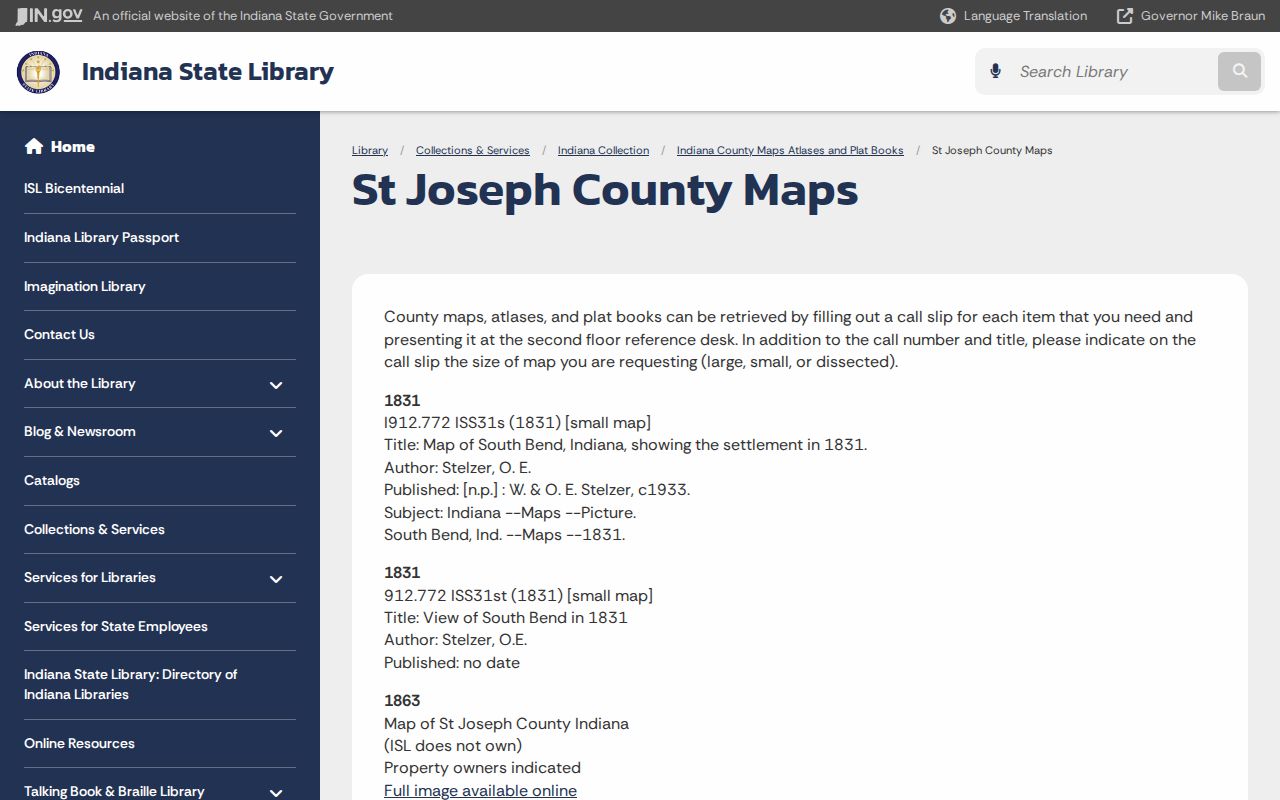
An atlas owner is a time-stamped clue. It is not a deed abstract. Take the name, road, township, and lot language and carry it back to the Recorder's books, IARA land records, library directories, probate files, and court records. The map tells you where to dig; the recorded documents do the proving.
St. Joseph Recording Requirements
St. Joseph County's Recorder posts a document requirements list. It reads like a catalog of rejection reasons. A deed can bounce for a missing acknowledgment. It can also bounce for no grantee mailing address. Or it may lack an Auditor stamp. Other common gaps include a missing cross-reference and an incomplete legal description. Some filings omit a preparer affirmation or a missing officer title. Notary defects and wrong fees cause rejections too. So do absent power-of-attorney references or missing signatures and court stamps. This is why a submitted document sometimes never reaches the deed index. The official checklist on the county page spells out each requirement.
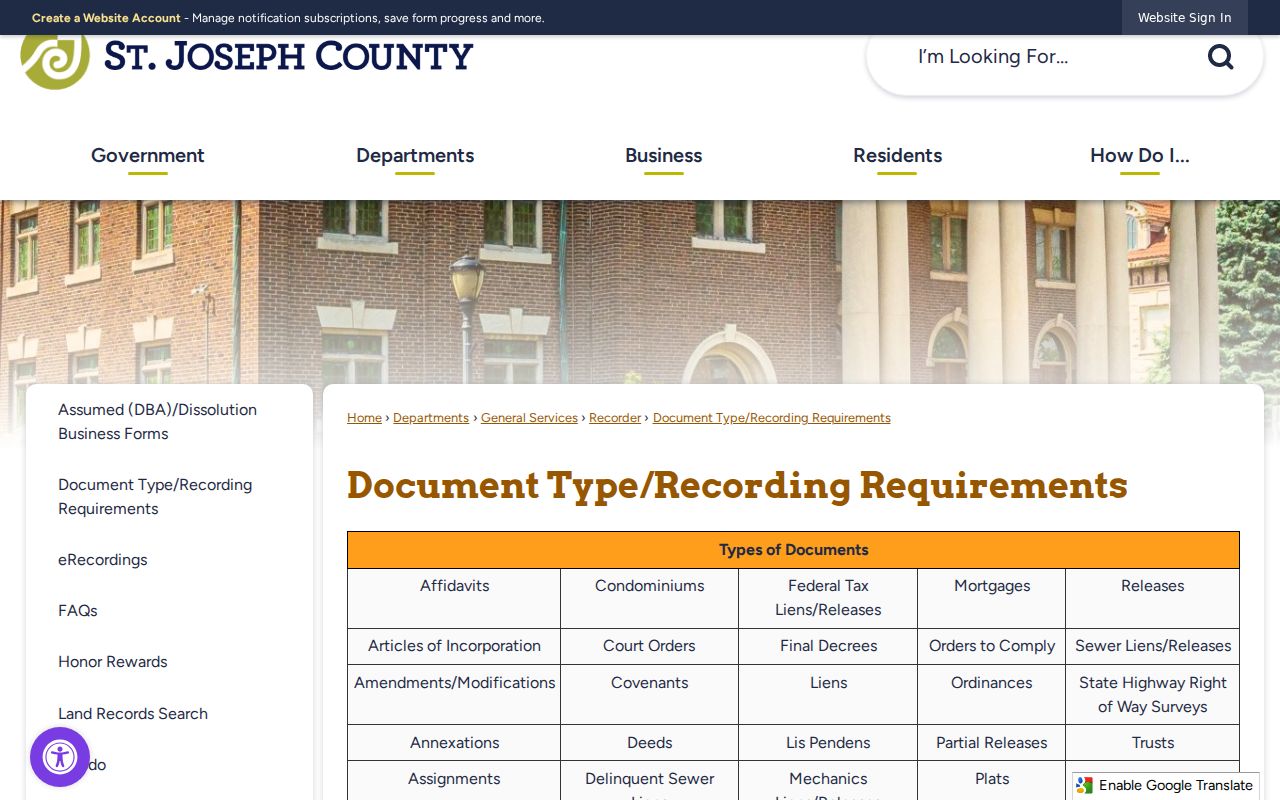
Recording means the document entered the public record. It does not validate every claim inside the document. An unrecorded interest can still exist, so recording is acceptance, not proof.
Fraud Alerts for Recorded Names
St. Joseph County runs a free Property Fraud Alert service. It watches new recordings for name matches. Enroll, and the county notifies you when a document is indexed under your chosen name. That notice is a prompt to pull the instrument and inspect the record yourself. The alert does not block a recording. It does not verify anyone's identity or substitute for routine deed review. The official Property Fraud Alert page describes the service and enrollment.
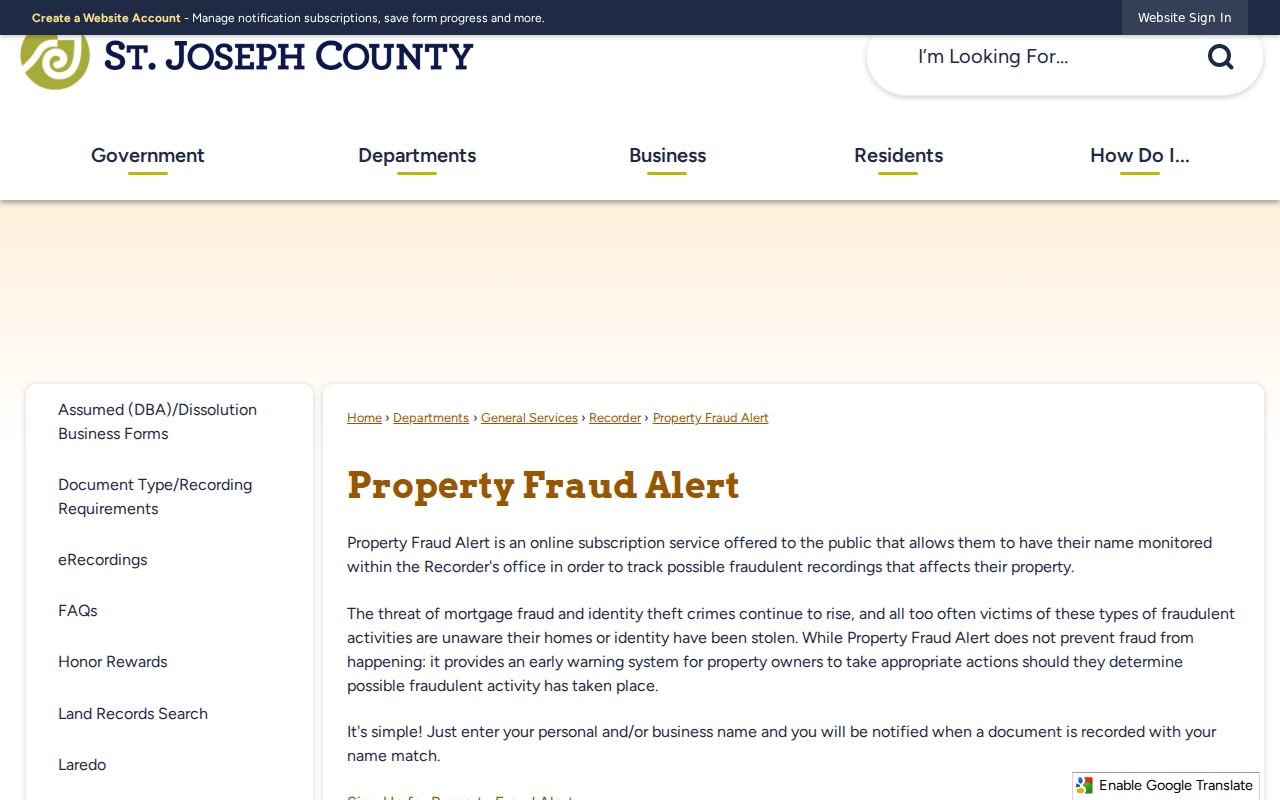
Treat an alert as a starting bell. Obtain the instrument. Compare its legal description against the parcel. Contact the Recorder or a qualified professional if a filing looks false. Acting quickly limits the damage a fraudulent deed can do.
Note: A name-match alert may flag someone with a similar name. Check the land and party details before concluding anything.