
Inside St. Joseph County Tax Records
Three offices split the St. Joseph County tax record. The Assessor maintains values and property characteristics. The Auditor keeps tax ownership, deductions, parcel transfers, and tax-sale administration, while the Treasurer holds the bill, the balance, and the payment route. Attach the parcel key and tax year to every figure you handle. A value, deduction, or payment shown without its year can mislead.
| Field | What It Shows | Where |
|---|---|---|
| Land and improvement value | The two parts of gross assessed value | Assessor card and Indiana Gateway |
| Tax year and pay year | The assessment period and the later billing period | Parcel card and bill |
| Deductions | Flags that can reduce taxable value | Auditor and parcel card |
| Balance and payment | Current amount and payment route | Treasurer and MunicipalPay |
| Tax unit or district | The taxing jurisdiction assigned to the parcel | XSoft and county tax records |
Gross assessed value is not the amount due. It is not a sale price either. The bill starts from the assessed figure. District rates, deductions, credits, state and local rules, and the right year then shape the final amount. Indiana assesses real property at market value-in-use, while a deed or sales disclosure records a transaction under its own facts. For a closer look at those differences, see the St. Joseph County property value explanation.
St. Joseph County Tax Search Routes
No single screen answers every tax question in St. Joseph County, so the county links several official routes. LowTaxInfo serves as a county-linked tax and property lookup, while the XSoft assessment search accepts an owner name, address, or property number. For statewide assessment context, the Indiana Gateway assessed-value search covers every county in Indiana.
The XSoft suggestions can display State Number, Owner, Address, and Assessed Value. Its advanced page goes further. Sale date, sale price, building details, district, and neighborhood filters let you compare groups of parcels at once. Those broad filters suit comparison work, but an actual bill or payment still has to run through the Treasurer route.
Need a direct path? The LowTaxInfo tax lookup remains the county-linked starting point.
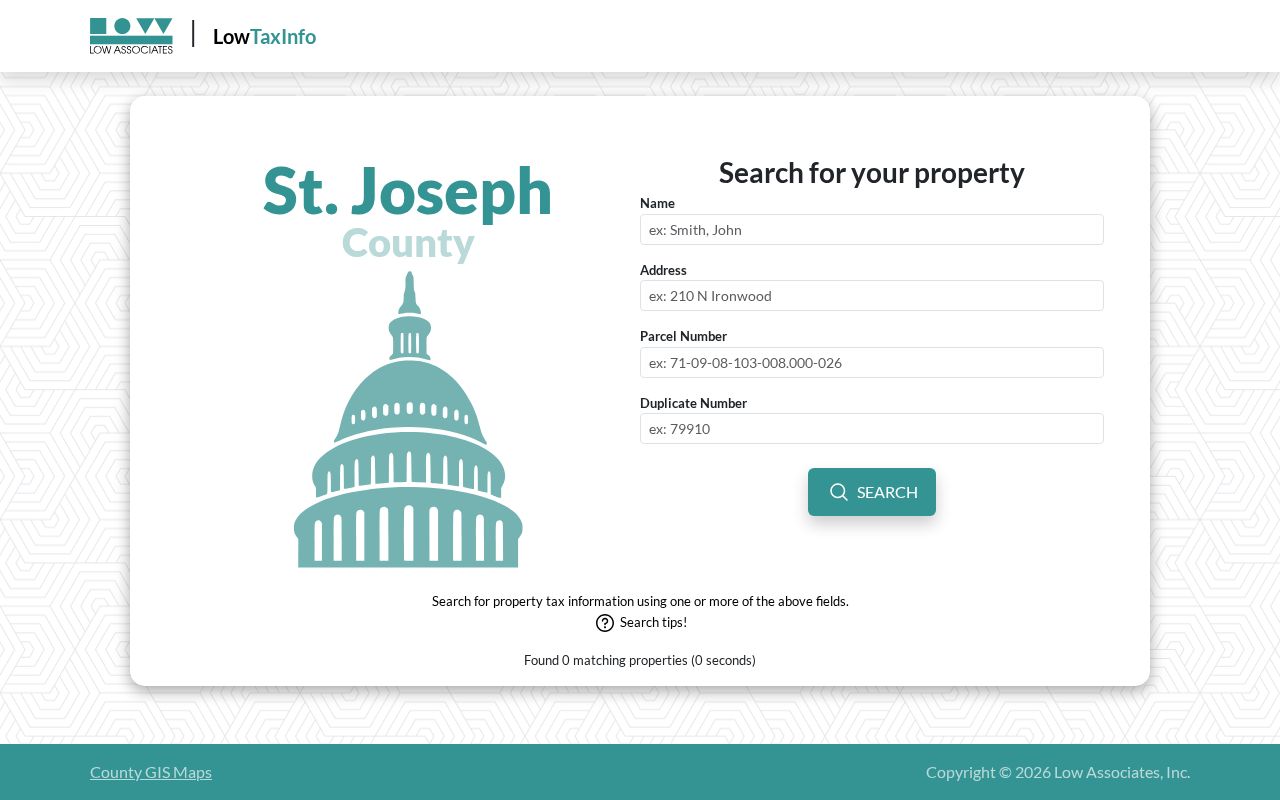
The county warns of a 24-hour lag. Check the posted time whenever a current payment or owner matters. The official Gateway page shows how users reach assessed-value data at the state level. Treat it as context.
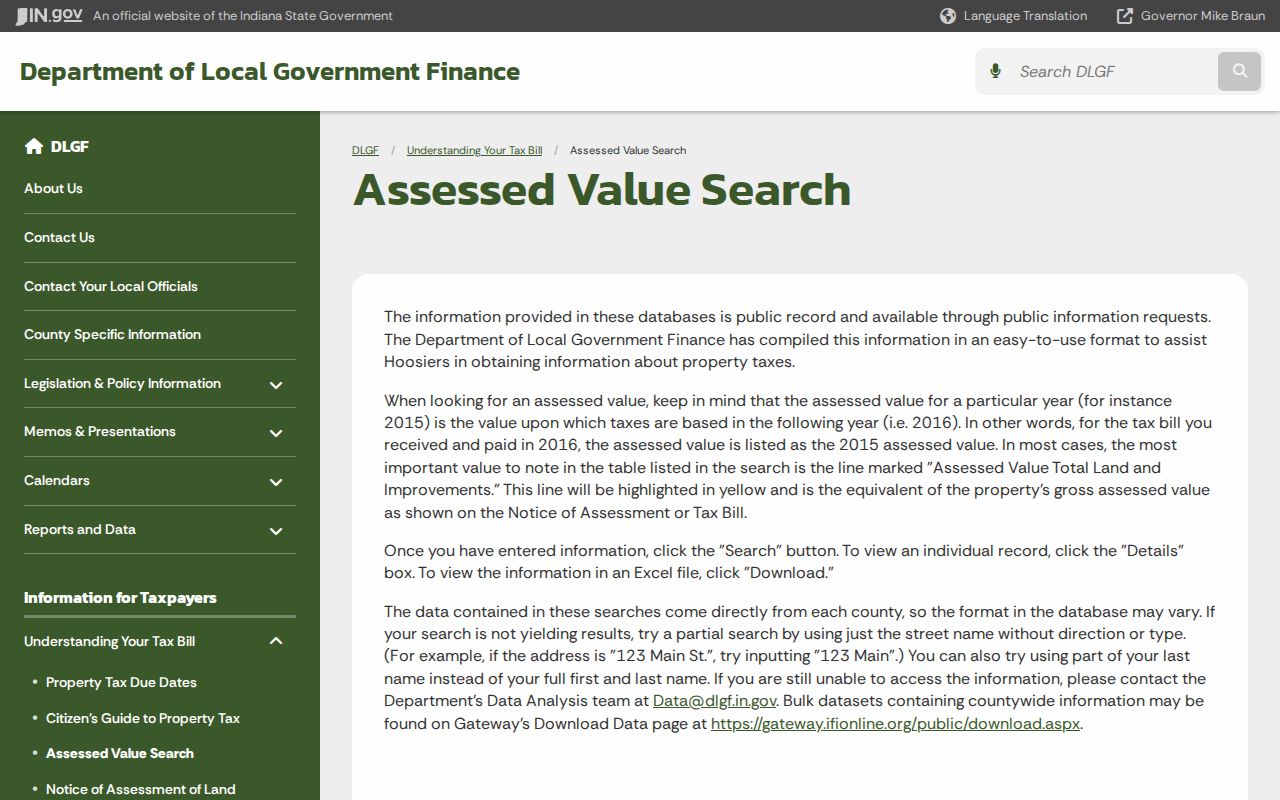
Gateway is a comparison tool. Match its gross land-and-improvement figure against the county card, never as a substitute for a current Treasurer balance.
Trace a St. Joseph County Tax Bill
Start with the exact parcel. A street search can return more than one unit or tract, and the owner shown on an old bill can be stale. Copy the full state parcel number and the short tax ID exactly as displayed. Treat neither portal as proof of deed ownership. Then move from assessment to payment.
- Search XSoft or LowTaxInfo by address, owner, or parcel number. Confirm the situs address and legal description.
- Record the land, improvement, and gross assessed values with their tax and pay years.
- Open the MunicipalPay tax route linked by the Treasurer and check the current balance or payment path.
- Review deduction flags with the Auditor. If a parcel is certified or sold at tax sale, stop and use the in-person redemption route.
The Treasurer also takes payment in person, on the second floor of the County-City Building. Mail goes to PO Box 4758, South Bend, IN 46634-4758. Include a self-addressed stamped envelope for a mailed receipt. The bill itself prints a telephone payment number, 574-586-5540. These channels matter when the vendor search fails or a paper receipt is needed.
- Assessed value
- The value assigned under Indiana assessment rules before the bill calculation.
- Levy
- The amount a taxing body raises, applied through the parcel's district and rate structure.
- Homestead deduction
- A property-tax reduction tied to eligibility and filing rules, shown through Auditor records.
- Tax lien
- A legal claim tied to unpaid tax, distinct from an ordinary open bill.
St. Joseph County's New Payment Route
The Treasurer page names MunicipalPay as the online payment system effective March 25, 2026. That date is a warning. An old bookmark can mislead. Vendors change; custodians do not. The St. Joseph County Treasurer still holds the underlying property tax record.
Record the date of every balance check. Status shifts fast. A cached search result may not show a later receipt, certification, or sale event, so call the Treasurer at 574-235-9531 when the online path and the parcel's status disagree.
Note: A payment vendor is an access route; the St. Joseph County Treasurer remains the source for a current tax balance.
Offline St. Joseph County Tax Access
Online access is only one channel. The Treasurer's public counter sits on the second floor of the County-City Building, 227 W. Jefferson Boulevard in South Bend. Published weekday hours run 8:00 a.m. to 4:30 p.m. Mail payments go to the St. Joseph County Treasurer, PO Box 4758, South Bend, IN 46634-4758. Include a self-addressed stamped envelope for a mailed receipt.
The Auditor and the Plat Room share the same government complex. They handle transfer, deduction, parcel, and redemption questions. Their hours have been temporary, so check before visiting. Bring the exact parcel number, the tax year, the pay year, and the bill or notice that raised the question. Include the status wording too. A focused request routes faster than asking for every record tied to an address.
If the record is not in a portal, Indiana's Access to Public Records Act, IC 5-14-3, permits a request for any existing public record unless an exception applies. Name the card, bill, notice, receipt, parcel key, office, and date range. The agency need not create a new analysis. It also need not answer a broad research question. Inspection works well as a first request when the file is large.
St. Joseph County Assessment Cards
St. Joseph County pairs its parcels with a neighborhood-level lookup. The Assessment Neighborhood Map takes an address or tax ID and returns the parcel on screen. Click the parcel and open the popup's PARCPRC link. That link opens the property-record card, which can carry land and improvement values, building style, year built, area, property class, tax unit, and deduction flags for the St. Joseph County parcel.
Timing matters here. The map's own instructions say the linked cards refresh once a year. That is slower than the GIS FAQ's two-week parcel-attribute cycle. Save the card year before comparing it against a bill or tax roll figure.
The official assessment-neighborhood screen displays these results for each parcel.
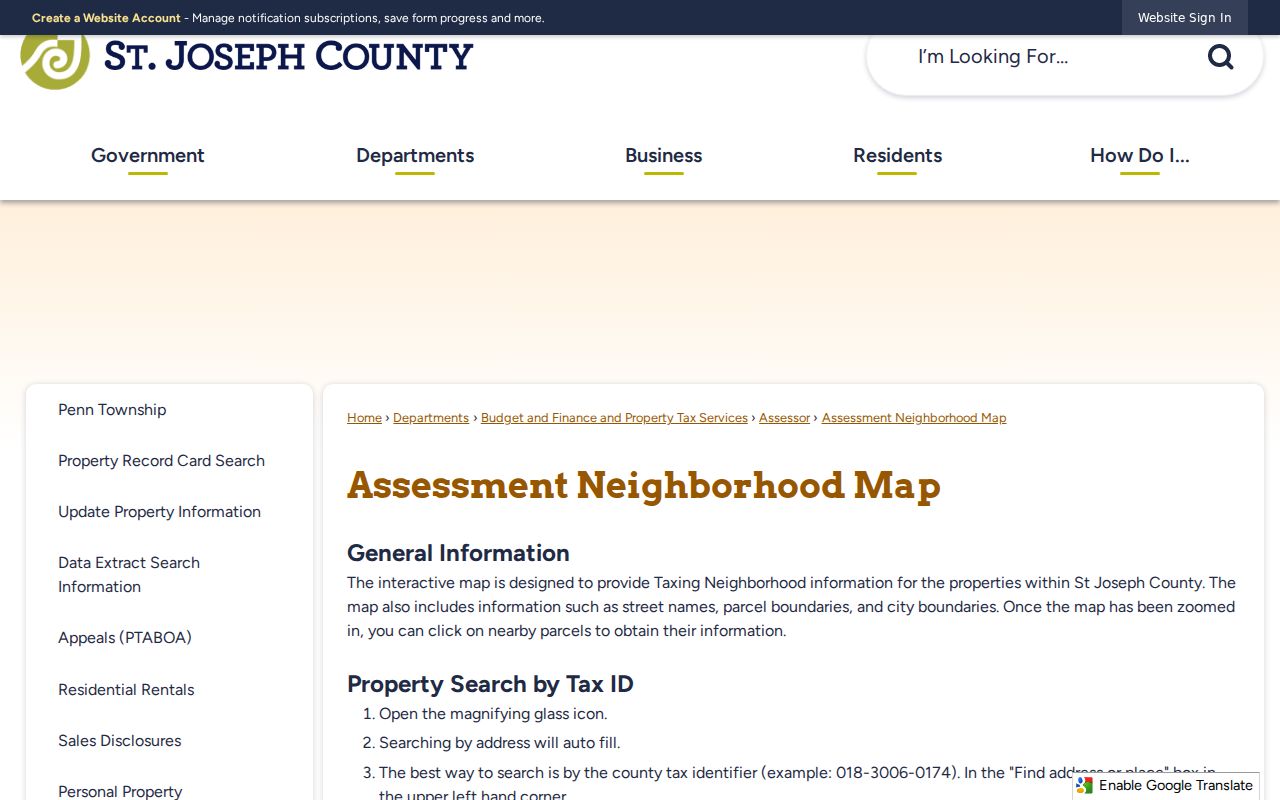
The PARCPRC link converts a map click into a dated property-record card. For value details, that card beats the parcel outline alone.
Indiana Rules Behind County Tax Values
Indiana assesses at a 100 percent ratio. The Department of Local Government Finance frames the standard as market value-in-use. That standard is tested through ratio studies. The studies compare assessed values with qualifying sale prices. Annual trending has applied since 2002. None of that guarantees a parcel's assessed value matches its most recent sale price.
Assessors weigh property characteristics, local sales, and cost, income, or sales-comparison evidence. A sale disclosure adds transaction facts. But financing terms, family relationships, or unusual conditions can knock it out of comparable use. Match the right parcel first, then the right valuation date.
St. Joseph County Tax Deductions
The St. Joseph County Auditor handles deduction and transfer work. Deductions normally carry over without annual reapplication, the county says. A sale or title change forces a new application. The mortgage deduction ended with the 2023-pay-2024 cycle.
A deduction flag on a parcel card is only a clue to eligibility. It is never the final word. A May 13, 2025 county alert reported that Senate Bill 1 reshaped assessment, deduction, and exemption processes. It also urged residents to subscribe to county updates. Ask the Auditor for the current deadline before relying on an older cycle's date.
Note: A deed transfer can affect a deduction. This can happen even when the property use has not changed.
St. Joseph County Tax Sale Status
A delinquent bill, a tax-sale notice, a certificate, a redemption, and a tax deed are distinct stages. Together they form one process. The Auditor states that St. Joseph County holds two tax sales per year. The Auditor also points to the Zeus Auction platform plus county ArcGIS maps for unsold parcels. An ordinary fall sale usually carries a one-year redemption period. A Commissioners sale usually allows 120 days. Whatever the specific notice for the parcel says controls.
The standard MunicipalPay payment route refuses property certified or sold at tax sale. Those redemptions go through the Auditor in person, per the Treasurer. Track the parcel key. Track the sale type, notice date, and minimum bid. Also track redemption status and any later Recorder instrument before drawing conclusions.
Tax-sale fork. Do not treat an auction listing as a completed transfer. Verify redemption and the later recorded deed.
Label St. Joseph County Tax Years
A parcel card shows a tax year and a pay year. A notice carries its own issue date, and a payment record shows a transaction date. Never collapse them into one vague year. Write down the exact field label. An assessed value may sit on an earlier valuation date than the bill's due date, and a later portal capture changes nothing about which cycle the figure belongs to.
Ownership deserves the same care. A bill's name reflects the tax system at that moment. A newly recorded deed may reach the Recorder before it reaches the Auditor, the assessment display, GIS, or the tax portal. The county describes LowTaxInfo as roughly 24 hours behind the tax system. Plat Room transfers usually lag recording by one to three days, sometimes longer. Compare dates before calling a mismatch an error.
For clean notes, keep the state parcel number, short tax ID, situs address, legal description, tax unit, tax year, pay year, assessed-value parts, deduction flags, balance status, and capture date. With that inventory in hand, the Assessor, Auditor, and Treasurer can see exactly which St. Joseph County property tax record needs review.
Contest a St. Joseph County Assessment
An assessment challenge starts with written notice to the local assessing official. Indiana's appeal guidance gives a Form 11 appeal roughly 45 days. No Form 11? The deadline is the later of two dates. It is either May 10 in the tax-bill year or 45 days after the bill. Always check the date printed on the actual notice.
Good evidence might include sale information, comparable properties, a listing, offers, or a licensed appraisal. An appraisal is not mandatory. The county Assessor serves as secretary to the Property Tax Assessment Board of Appeals. This board is known as the PTABOA. If the matter is not resolved locally, later Indiana Board forms and deadlines may apply.
Appeal window. A Form 11 generally starts a 45-day period. File with the local assessing official and keep proof of delivery.
Value Indiana's St. Joseph Pilot
Board of Commissioners materials from March 2026 describe a Value Indiana pilot. The pilot is run by Soka Inc. Under that pilot, St. Joseph County CAMA data would be paired with verified sales for valuation analysis. CAMA stands for computer-assisted mass appraisal. It is the data an assessor uses to value many parcels. It also covers the modeling applied on a common basis. The agenda material identifies the county as one of only two participating jurisdictions statewide.
The pilot does not prove that any particular parcel changed value. Treat it as a dated public initiative instead. A parcel claim still rests on the actual assessment card. It also rests on the notice, the tax year, and any appeal record. Keeping that distinction clear prevents a current project update from being mistaken for an individual tax decision.