
Trace Former St. Joseph County Owners Transfer by Transfer
A backward chain begins with a parcel you know and moves deed by deed. Each row marks one transfer. No row alone proves continuous ownership from a name.
| Transfer point | Grantor to grantee | Deed form | Reference |
|---|---|---|---|
| Newest recording | Prior owner to current grantee | Warranty, quitclaim, trustee, or other deed | Recorder instrument |
| Earlier acquisition | Earlier grantor to that prior owner | Type shown in index and image | Instrument or book/page |
| Estate or court event | Representative, heirs, or ordered transferee | Representative or court-linked deed | Case and instrument |
| Book-era transfer | Indexed parties for the same tract | Historic conveyance | Deed book and page |
Never skip a row just because a surname repeats. Family transfers, trust changes, estate deeds, tax-sale deeds, and court orders can each shift the interest.
Start the St. Joseph County Former-Owner Chain Online
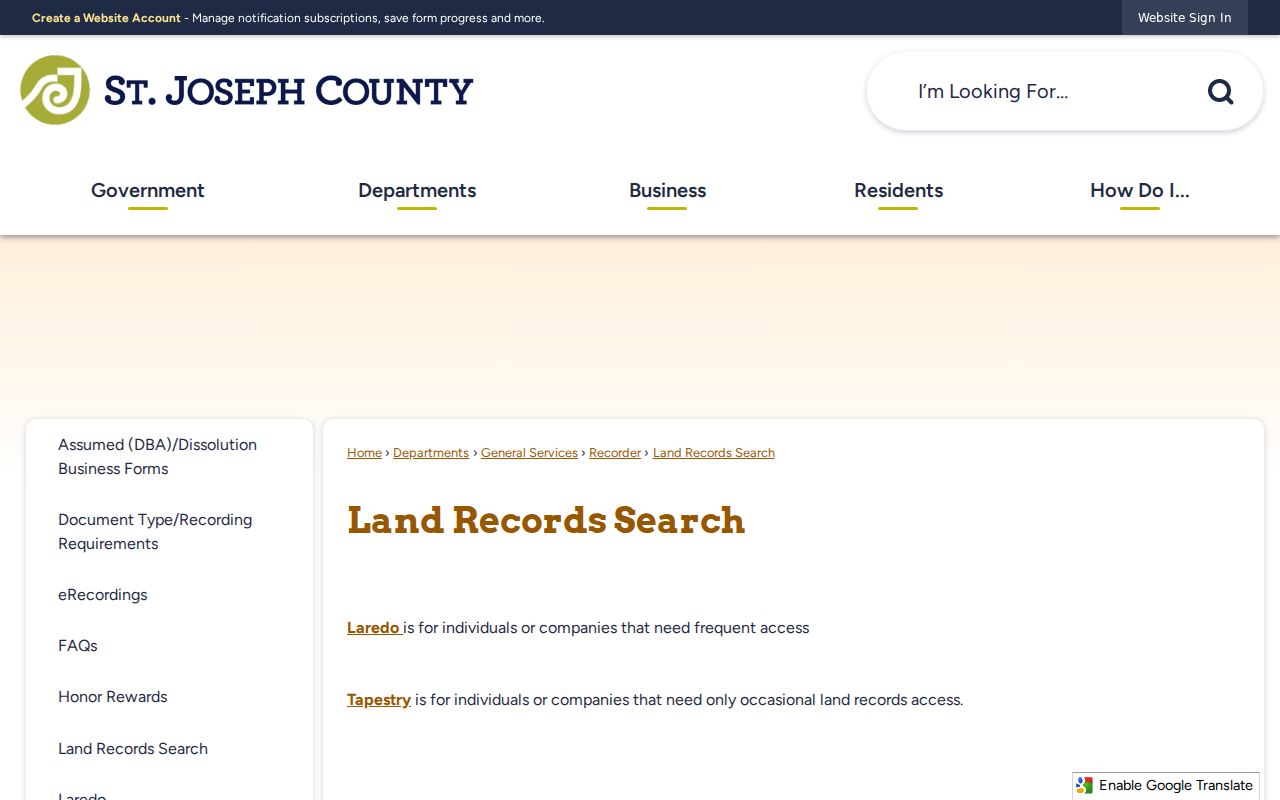
The Recorder's land-record guide gives three ways in: Limited Data, subscription Laredo, and occasional-use Tapestry. Laredo offers full index inquiry plus digital images from January 1992 forward. Tapestry searches by name, date, document number or type, tract, subdivision, parcel number, and consideration. The county Recorder's page itself lays out these sources for rebuilding a previous-owner chain. Save the instrument number for every hit. Record the recording date and document type. Note the grantor, grantee, and legal description. Also save the book and page plus image access, so nothing from the deed records gets lost. Search by party and by parcel. An older deed may lack the modern tax number.
Access plans can shift what images cost or how they open. Every result still has to match the same land.
Walk the St. Joseph County Deed Chain Backward
Start with the newest grantee. Find that deed's grantor. Then search the grantor as an earlier grantee.
- Locate the current acquisition deed and verify its legal description.
- Record grantor, grantee, instrument, type, date, and prior reference.
- Search the grantor as a grantee in an earlier range and match the land again.
- At the online limit, carry the book, page, tract, and party into older indexes.
- Grantor
- The party conveying the stated interest.
- Grantee
- The party receiving the stated interest.
- Reverse index
- An index route for working backward through party names.
- Chain of title
- The ordered instruments affecting the same land.
Keep St. Joseph County Prior Owners on the Same Land
Addresses make weak anchors over long spans. Roads get renamed, addresses reassigned, and postal cities cross government lines. Anchor instead to the legal description. Use the subdivision and lot, section and tract, acreage, and any prior-instrument reference. Splits and consolidations break a parcel-number search. The Auditor's Plat Room tracks those changes. A consolidation issues one parcel number while the lot lines stay. It can be reversed. So a new key never means a new surveyed boundary. Note: Keep both the full 71-... state number and the short tax ID when crosswalking a modern parcel.
Use St. Joseph County's Dated Map Ladder
The Indiana State Library map list covers research leads from 1831, 1863, 1875, 1900, 1910, 1911, 1913, and 1923. It also lists plat books from the 1920s through 1941. A labeled owner is a dated clue, not a deed. Note down the map year, tract, roads, and adjoining owners. Then chase the matching deed record. The 1886 to 1887 W.E. Farr South Bend directory at Notre Dame can clarify an old street. A directory occupant is not automatically the owner of record, though.
Reconstruct St. Joseph County Past Owners Across Estates
A death may leave no routine sale next in the sequence. Probate appointments, wills, heirship findings, court orders, and personal-representative deeds can bridge that gap. Search the Clerk or MyCase for the authority. Then return to the Recorder for the land instrument itself. Business and marital name changes deserve the same care. Search initials, exact entity names, trustee capacity, and former spellings. Join records only through matching land or a clear prior reference.
Explain St. Joseph County Ownership Place-Name Changes
Municipal history explains why an old deed names a township, subdivision, or a different city context. Mishawaka's records note the 1905 Great Annexation. River Park history near 1910 gives another boundary clue. Annexation alone proves no transfer. Compare the historic text against a plat and modern GIS map. A service agreement, zoning act, sewer easement, or annexation file can change context without ever changing the deed's owner of record.
How Far Back St. Joseph County Former-Owner Records Reach
Laredo describes coverage from 1992. The county publishes no single earliest online year for every deed product. That gap does not mean older records are missing. Ask the Recorder in room 321 about deed books, indexes, microfilm, scans, and staff help. From there, widen the search. The Plat Room, State Library maps, IARA survey and tract material, St. Joseph County Public Library collections, Notre Dame directories, and probate files all hold earlier material. County history records no courthouse fire or countywide deed loss.
Coverage limit. The verified 1992 statement describes Laredo digital coverage, not destruction of St. Joseph County ownership records before 1992.
Lawful use. Former-owner research supports house history, estate work, and property diligence. Never use historic or current clues to track or harass a person.
Document Gaps in Former-Owner Research
No verified earliest online image year applies to every St. Joseph County deed record. Treat Laredo's January 1992 image statement carefully. It does not mean earlier deeds are absent. Ask the Recorder about the reverse index, deed books, microfilm, and the book or page cited by the first online instrument. When a grantor cannot be tied to the same land, leave an explicit gap in the chain. State Library atlases, SJCPL directories, FamilySearch catalog entries, probate files, and historic maps supply names and time clues. Still, only a matching conveyance or a court-created title event should extend the former-owner chain for St. Joseph County property records.